Review · Tokyo Wire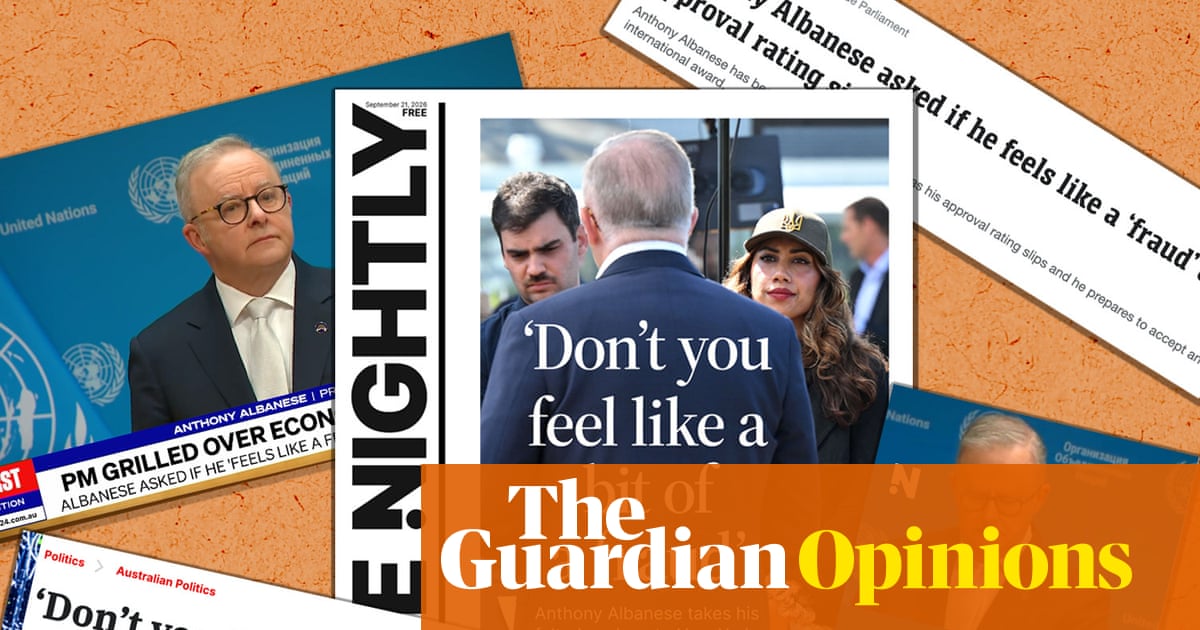
I t’s a fundamental rule in journalism that you should never want to be the story. Sometimes it’s unavoidable, as when reporters are targeted or shut out by political parties. But at other times it can look a little more like headline seeking.
Enter the prominent journalist and author Latika M Bourke, writer-at-large for The Nightly in London and co-host of ABC Radio National’s Global Roaming program (she added the M after leaving the Sydney Morning Herald, where her byline was plain old Latika Bourke ). On Monday, Bourke was in New York attending Anthony Albanese’s press conference on the sidelines of the United Nations general assembly. The PM was spruiking Australia’s bid for a non-permanent seat on the UN security council for 2029 and 2030.
Initially, a UN report on racial discrimination, which found Indigenous children were over-represented in Australia’s justice system, dominated questions. Then Bourke stepped in with her gotcha moment. “Here in New York on Wednesday night, you will receive an award for being a global citizen,” she said, pointing to an accolade handed out by the Atlantic Council for his work in the Pacific.
Sign up to get Guardian Australia’s weekly media diary as a free newsletter “Don’t you feel like a bit of a fraud accepting this award when, at home, you screwed up the response to the worst massacre since Port Arthur? In the polls, you are taking Labor to one point shy of Julia Gillard when you rolled her, and your net negatives are worse than Scott Morrison.” Albanese had a one word response: “No.” The world could have moved on. But instead the Nightly’s front page on Monday was splashed with a picture of Bourke in a Ukrainian army baseball cap, gazing in disappointment at the PM, accompanied by the quote: “Don’t you feel like a bit of a fraud.” “Latika M Bourke asks the question that hits close to home,” the text read.
Latika Bourke, left, with the ABC’s Global Roaming team – Hamish Macdonald, Geraldine Doogue and Kylie Morris. Photograph: supplied ABC Again, the world could have moved on, but then the “fraud” line got a strong run in a string of other publications, including News24 , news.com.au , 2GB and the Herald Sun . The deputy executive director of the Institute of Public Affairs, Daniel Wild, praised Bourke on The Rita Panahi Show, asking “Why don’t more journalists do this?” Panahi was similarly gushing, describing it as “the best question I have heard posed to the Australian prime minister”.
If she’s right, we’re in a grim state of affairs. A spokesperson for the ABC said Bourke’s role with Global Roaming “does not mean the ABC endorses the opinions she expresses outside the editorial output of the program” and her appearance in New York “was not as a representative of the ABC”. “ABC workers are members of the communities they serve and the ABC does not wish to unnecessarily curtail their engagement in civic life, including by expressing personal views outside of their ABC work,” they said.
Bourke was approached for comment. Now let’s hear from ‘the KKK guy’ Speaking of fundamental rules of journalism, another may be: if you interview members of the Ku Klux Klan, you should have a really good reason. On Sunday, 9News aired the first episode of Trump’s America, looking at the “deep political and social chasms” separating communities in the US.
Reid Butler headed to Arkansas to interview Thomas Robb, who he described as “the KKK guy” – Robb is the national director of the Knights Party, a faction of the clan. Why? To interrogate “ugly racism”.
Robb, apparently unprompted, brought up Pauline Hanson , saying the One Nation leader was “demonised by the same element of people that wants to demonise us”, and agreed it was “encouraging” to see her doing well. Hanson was quick to go on the front foot, claiming the network was “attempting to draw a link between the white supremacist organisation and One Nation”. “Nine should be ashamed of itself,” she wrote on X .
The national news director at 9News defended the reporting, saying “the inclusion of Mr Robb’s comments does not constitute endorsement of those views, nor of the comparison he chose to make”. “Their inclusion was an editorial decision made in the context of reporting on the racial and political divisions examined by the documentary.” Total croc Fewer salties than the west ... the Fitzroy River in Rockhampton, Queensland. Photograph: Sylvia Liber/AAP Nothing gets international media going like dangerous animals in Australia.
So when it was announced that central Queensland’s Fitzroy River, a crocodile habitat , had been given the green light to host rowing at the 2032 Brisbane Olympics, a media frenzy ensued. “River with 500 crocodiles chosen as Olympic rowing venue,” the BBC declared last week, accompanied by alarming footage. There were just a couple of issues.
For one, the video showed crocs at Fitzroy River in Western Australia, not Queensland, and the estimated number of saltwater crocodiles in the area of the correct river where the rowing will take place is many fewer. Queensland’s environment department reported 32 sightings in the Rockhampton region in 2023. Corrections were issued and some of the BBC footage was deleted , though one video still claimed there were 500 crocodiles in the river as of Thursday.
The Nationals leader, Matt Canavan, was quick to weigh in on the BBC report, angrily calling out the broadcaster for “BS FAKE NEWS”. skip past newsletter promotion after newsletter promotion “The BBC used stock footage from the WRONG Fitzroy River,” he wrote. “The 500 figure is also total BS.” The BBC said the 500 figure was provided by Reuters, which has also issued a correction to its story “to clarify that Australian government estimates put the number of saltwater crocodiles in the Fitzroy River at around 100, not 500”. Unfortunately, the ship had already sailed.
The “500 crocs” figure, which has no scientific backing, was also quoted in the Daily Mail , the UK’s Telegraph , Vice , People and the Sun , among many others, but no such corrections have been issued across the mastheads, and the stories remain live and widely shared. More Four Corners misery The ABC’s ombudsman has found two Four Corners programs by the bikie turned journalist Mahmood Fazal, Cocaine Nation and Meth Highway, failed to meet the public broadcaster’s editorial standards. (Fazal’s employment was terminated for separate reasons, the ABC’s managing director, Hugh Marks, said in May .) Two Four Corners episodes by Mahmood Fazal were taken down in July amid concerns about the veracity of sources. Photograph: Supplied ABC The ABC board requested an independent review of the programs, broadcast in 2023 and 2024, after concerns raised in the media over the veracity of anonymous sources.
Both programs and associated content aired on Background Briefing have since been removed . The ombudsman found audiences were giving a “misleading impression” of sources in the programs, “the basis on which the ABC was relying on them and the level of confidence that could reasonably be placed in their claims”, which “undermined confidence in the integrity of the programs”. Among the reasons for the breaches were “management’s failure to properly interrogate” ...
“a culture that favoured limiting knowledge about sources given perceived risks” and “insufficient verification and factchecking”. The ABC has accepted the ombudsman’s recommendations in full. In a statement, it said managers were “working closely with editorial leaders to ensure every team understands and consistently upholds the ABC’s Editorial Policies”.
“The ABC will update its editorial guidance on attribution and anonymity to provide further clarity around editorial oversight and review and to reflect the high standards expected regarding the use of anonymous sources.” Every senior editorial figure who was involved in the programs has now left the ABC, including the head of investigations and current affairs, Jo Puccini, who resigned last month , the former director of news Justin Stevens, the executive producer of Four Corners, Matthew Carney, and the program’s supervising producer, Alice Brennan. Chessell gambit Less than three years after becoming editor of the Australian Financial Review, James Chessell has jumped ship to edit Rampart, the subscription-based business and finance publication launched by the AFR’s former Rear Window columnist, Joe Aston, last year. He’s in good company.
According to Rampart’s author page, five AFR alumni write for the publication, including Amelia McGuire, Rampart’s senior writer, who previously covered technology for the AFR, and freelance journalist Julie Hare, who was the AFR’s award-winning education editor. ‘Fantastic contribution’ ... James Chessell has left his role as AFR editor to edit Rampart.
Photograph: Sam Mooy/Getty Images In an article explaining why he was starting Rampart last February, Aston said he still loved the AFR but was confident “the subscription revenue I was generating for Nine was many multiples of what Nine was paying me”. The AFR’s editor and longstanding Nine employee Cosima Marriner will take over from Chessell as the publication’s first female editor-in-chief when he departs on 9 October. The AFR’s article confirming her appointment waited until the last line to reveal Chessell’s next move.
The managing director of publishing at Nine, Tory Maguire, thanked Chessell for his “fantastic contribution” in an internal email to staff and wished him the best “in his new endeavours”. In an update to readers, Aston described Chessell as “the best newspaper editor in the nation” and said “there is no one in our industry I am more aligned with on what great journalism looks like”. Chessell was approached for comment.
Source: The Guardian